
Are You in a Relationship With a Narcissist? (Transcript)
Oct 22, 2026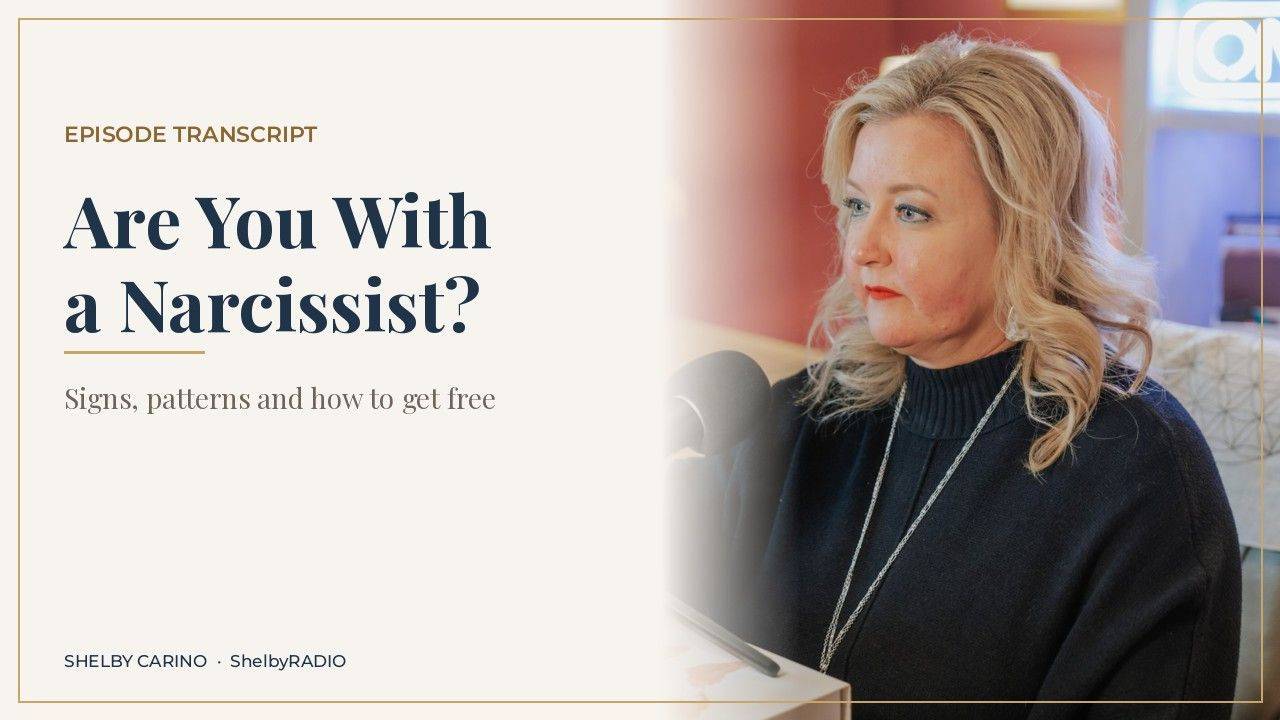
Episode transcript, ShelbyRADIO · 103 minutes
Short answer: You may be in a relationship with a narcissist if the other person constantly needs admiration, makes every conversation about themselves, can't handle criticism, blames you for everything and shows little real empathy for how you feel. People on a spiritual awakening path often attract narcissists because they carry the empathy and feeling that a narcissist lacks, and the relationship becomes a mirror that teaches them their own worth. That kind of narcissism rarely changes, no matter how much light you pour into it. The way through is to see the pattern clearly, stop feeding it, take your power back and step away.
If you're in an abusive relationship or don't feel safe, call or text the National Domestic Violence Hotline at 1-800-799-7233 (US) any time.
Listen: ShelbyRADIO podcast · Watch on YouTube
Key takeaways
- Empathic, awakening people are like a bug zapper for narcissists, because they have the feeling and empathy a narcissist lacks.
- Common signs: they always talk about themselves, live in fantasies of success, need the best of everything, can't take criticism, rage when challenged and rarely ask how you feel.
- There's a difference between finally making yourself important on a spiritual path and a narcissist's inflated ego. One breaks themselves down to build others up; the other breaks others down to build themselves up.
- Narcissism shows up on a spectrum, from the grandiose "look at me" type to the more vulnerable, insecure type who constantly needs reassurance.
- Narcissists rarely change. Arguing, confronting or mediating only feeds them, so the real shift is to stop giving away your light and step out of their force field.
- When you finally leave, it creates space for better things and people to come in, and you get your breath and your perspective back.
Full transcript
Lightly edited for reading.
Why this question matters on the awakening path (00:00)
Hello, and welcome to ShelbyRADIO. I'm your host, Shelby Carino. You made it into the episode, and that's always the hardest part. It's how life is: you can observe something from a distance and think about taking action, but sometimes the hardest thing is just getting started so you can hear the information and put it to use.
Today's question is a huge one: are you in a relationship with a narcissist? Why does this matter in spiritual ascension? If you think about what ascension is, it's about growing ourselves, expanding our consciousness and love. Unfortunately, when you're on a path of awakening into your higher self, it's not uncommon to brush across a narcissist at some point, or to be in a relationship with one.
The reason is that narcissists are extremely good at being all about themselves, based on an insecurity they run about themselves. They can't get past the inflated version of themselves because they lack feeling, empathy and emotion. Narcissism has been labeled a mental disorder. So one of the things people on a spiritual path have to learn is what narcissistic behavior is, what a healthy versus unhealthy view of it looks like, whether it changes in a person, and why we as spiritual beings attract narcissistic people into our worlds.
Relationships as mirrors (05:08)
The quick answer is that a spiritual path is about breaking down the ego, on a human level and on a spiritual level, because we have both a human ego and a spiritual ego. And we learn through relationships. The relationships we bring in act as mirrors for certain lessons we have to see, encounter, experience and learn from.
Someone of the light who is ascending, who is naked in front of that mirror, can take these learnings from a narcissist's behavior and reflect them back to self: "It's okay for me to take care of myself. It's okay to step into my power. It's okay to feel confident about myself." As a spiritual being healing yourself, you go through the dark nights of the soul, the soul cries and a breaking down of the ego in order to be reborn.
With narcissism, it's more of a coping mechanism. They use an inflated ego, human or spiritual, to feed the insecurity they have, with no regard for how it affects other people. They go into a relationship for what it will do for them. They have no ethics and no ability to care what it does to someone else, and then they go on to their next victim.
This has always been around, but it's becoming more heightened now, because there's a clearer separation between people doing awakening work to dismantle and rebuild themselves and people running narcissistic patterns that have always fed off those in the light. The awakened person has the empathy, the feelings and the sensitivities, and until now it's been easy to overrun people like that. People like me, and probably you if you're listening, feel for people.
That's exactly what narcissists go for. They have no feeling or empathy themselves, so they go to the ones who do and pretend to have it too. If they're left alone with themselves, with no one to feed from, that's when they crumble, because they can't stand to be alone. They need someone constantly inflating them to have a sense of purpose.
My story: a marriage and a neighbor (10:44)
I'm talking about this today because I've been in a narcissistic relationship myself. In my twenties, I married that person. I was married at 26 and divorced at 30, because it's really hard to be in a relationship with a narcissist unless you're feeding the narcissist or you're one yourself. That was my first experience.
Fast forward to later in life, and I had an experience with a neighbor who was extremely narcissistic. I realized I hadn't fully healed my ability to see narcissism the way it needs to be seen, because I got sucked into that energy again. Clearly I had never healed it from the marriage, so it came back around through a casual connection with a neighbor, and that's how I ran the healing.
It brought up feelings like: Why did I let somebody do that to me? Why did I lose my posture? Why was I feeling so much for this neighbor and their family and children?
We never really escape narcissism on our path, because as enlightened beings who are constantly bettering ourselves, we're the biggest light bulb, bug zapper energy for narcissists. We have the empathy. We can be bamboozled in the feelings. We don't want people hurting, and we want to help them.
So the more we learn what narcissism really is, the more power we have, and the better we can tell the difference between someone in an awakening process who is exerting their power and getting into their truth, and someone who is truly running narcissism.
Defining narcissism, and where it may come from (14:56)
Let's define it. For this conversation, we'll call narcissism a disorder in which a person has a very inflated sense of their own importance. Now, on a spiritual journey there is a point where it's about getting to your sense of self and making yourself important. But there's a difference between a person who is finally saying, "I'm going to put myself first and choose what's right for me," and a narcissist running ego inflation.
When someone is of the light, their biggest journey on this planet is often getting to their own self-value, self-worth and self-importance. That's usually why they attract the narcissist: to reflect, "I need to grow my value. I need to grow my worth." They have the humbleness and empathy to take care of others while they're growing.
Narcissistic personality disorder is seen more often in men. Why might a man develop an inflated sense of self-importance? It may have come from the mother. If she was insecure or not strong in herself, it could have been easy for her to inflate her son in ways that weren't appropriate.
Or it could be the opposite: a mother who said he never did anything right and was abusive, and his coping mechanism became, "Then I'll inflate myself."
But do we really know what creates narcissism? It could be anything. It can clearly be passed down the generational line; I've met narcissists' families and seen exactly where it came from. It can also be environmental, like who you spend time with.
At the end of the day, if someone has a massive need to be admired, no regard for other people's feelings, can't handle criticism, turns things around to blame you and runs all kinds of entitlement, they're running narcissistic behavior.
Why empaths stay too long (20:04)
I've seen it again and again with clients. They've been in narcissistic relationships, and they give and give and give, then mentally take the hit for the disorder the narcissist is running. They find it hard to get out because they feel bad for the narcissist. Once you finally see that you're dealing with one, a spiritually sensitive person instantly feels sorry for them, because it's something out of alignment.
So they want to help even more, and they go back in, only to be told again that they're not good enough, everything is their fault, they don't care, they're causing the problems.
This is how narcissists survive: by being with light workers who hold the other side of the candle, the feelings and the empathy. There's an imbalance there. The only way the light worker gets out is to leave and know that that kind of narcissism doesn't change.
Clients ask me, "What if they wake up? What if they come to themselves?" And I say, "Haven't you been doing the work? Haven't you been in that relationship with them?"
"Yes, Shelby, I have." "Then why haven't they changed?" You've been reflecting the light back, and they're choosing not to receive it. Their walls are too high, and even the closest person bringing all that light can't change it.
So you have to walk away. That's also why, when a relationship with a narcissist ends, they'll have another victim within days or weeks. It's how they feed, and when you stop feeding them, they have to find another place.
Sign one: it's always about them (23:48)
Through a four-year marriage and through more casual friendships with narcissists, I've noticed one commonality: they love to talk about themselves. You may say, "Well, I like to share things about myself too." Yes, but on a spiritual path, the higher you go in your own worth and value, the less you find you need to talk about yourself, unless you're in a profession like mine where you share your story ethically to empower other people, not to inflate your ego with all your accolades and awards.
Putting the pieces together between my marriage and the neighbor, I noticed every time that person came into my world, they only talked about themselves. They were also always about how they looked, their clothing and shoes, and how they presented themselves. Each of them would inflate their talent and achievements, even when it had nothing to do with the conversation. Things were exaggerated, not an accurate picture of their life, painting it as perfect.
So think about it. Have you been in a relationship with a narcissist? Did you grow up in a family of them? Do you have friends who run this behavior?
And how long do you need to see it before you exit stage left and say, "I've seen what I needed to see. I'll use this for my learning, shift my process and move on"?
Narcissists have little to no regard for the people around them, whether it's adults, animals or children. They rarely ask how other people are feeling or what they think. If they do act like they care, it's often to gather information they can use to tie an unethical psychic web to their victim and control the situation. That's why they're drawn to highly spiritual, light worker, psychic individuals.
We all have those abilities somewhere; it's about how they're used. That's why I'm all about empowering people to develop their spiritual communication channels. It's a level of protection.
Narcissists lack empathy, and you can't teach someone empathy. You either have it or you don't. Even when they say, "Oh, I feel bad," they may just be going through the motions of what they're supposed to say. Without empathy, they can't recognize any need but their own, and they'll always flip things to make it about themselves, using other people's feelings to do it.
I'm a Pisces, all about feelings and emotions, and I've had significant narcissistic relationships so I could strengthen my emotions and feelings and not get sucked into that web again. It's a powerful web.
You could be having a profound conversation with them about what's going on in your life, and all of a sudden they're talking about their new car or new job. There's no real exchange. If it's always "me, me, me," and they use that manipulation so you keep giving more and more, pay attention to who's in your circle. It's exhausting.
Sign two: fantasy and the best of everything (33:08)
Narcissists are big on fantasy. We all fantasize, but they have elaborate fantasies about their success, how brilliant, powerful or good they are, usually in the area where they're lacking. Do they live in a fantasy world most of the time? Do they have to have the best of everything?
My ex-husband had to have the best car, the best clothing, the best status, the best places to live. He was a Gemini, and Geminis can appreciate luxury. My husband now, Joe, is also a Gemini, and the difference is huge. Joe is balanced, has been through the spiritual awakening fire and still appreciates luxury, and there's nothing wrong with that. But his whole world has never revolved around it.
With my ex, the spiritual energy I brought illuminated him and made him want more and more. It always had to be about him and his career. He would come home with inflated stories about how everyone in the industry was reaching out to him, but there was never, "How was your day? What's going on with you?"
The fantasy is how narcissists ward off the emptiness they feel inside, so they can feel special and in control. They're never rooted in reality; they're always somewhere else building a story. That's why some turn to drinking or substances, because they don't want to be in reality. When they are in it for too long, frustration hits, because they realize they aren't achieving what they fantasize about, so they go right back into the fantasy.
Superiority and control in a family (37:20)
Because a narcissist has to believe they're superior, they're very good at taking a common human pattern, intensifying it and shifting it to work on their behalf. With the neighbor's family, the man ran the old paradigm: "I'm the man of the house, the provider. I bring home the money, so everyone caters to me." His wife also worked, but dinner had to be on the table, and the daughters had to cater to Dad.
Everything was about what everyone did for him, with no balance of him giving back. It created a very tense household that eventually came apart, because at some point everybody went to find their own power.
Watching that day in and day out, I realized how narcissism feeds through a whole family. I'd been married to one person for four years and dealt with selfish narcissism, but here was an older, more established version and how dangerous it was when it infiltrated an entire family. He would manipulate situations, install things like, "My child wanted this, so now you have to take care of it," when the child never wanted that. It was a way to control the child, the wife and the whole scenario.
To maintain their feeling of superiority, narcissists belittle others and focus on their flaws, real or made up. It's how they hide their own shortcomings and preserve their self-image. What ends up happening is they destroy the emotional well-being of the people around them. I get clients whose entire self-image, self-worth and self-value have been destroyed by a relationship with a narcissist, whether romantic, casual or in the family, and they have to go down the path of healing those energies.
Narcissists constantly want praise because they're so insecure, and if you say one bad thing, you've "damaged their self-esteem." So what does the empath learn? "I can't stand up to this person because they're fragile." You lose more of yourself, and it inflates the narcissist even more.
Entitlement, criticism, rage and envy (43:24)
They expect to be recognized as superior even without achievements to back it up. The minute you take that away, by giving feedback or a comment that shines a light on their insecurities or flaws, they become highly reactive. It can turn into a narcissistic rage, where they lie, divert the conversation or move it somewhere else, because they can't have a light shone on them.
They also run entitlement: expecting special favor and expecting you to fulfill their requests without question. If you don't, they become impatient and angry, especially if you're in their close circle, a partner, close friend or family. In their view, you exist to serve what they need, and if you can't, you're out.
Think of a toddler who never learned they aren't the center of the universe, who never got told, "You can throw your tantrum, but we're going to keep moving forward." I've seen narcissists jump from one person to the next to feed what they need, including family: "That's not what I need anymore. I'll go find a new family." That's not the same as an awakened person who has moved so much energy they no longer have rapport with their family and create a soul family. I'm talking about people who have no loyalty to growth, because they have no empathy.
You'll even find them in churches, wearing the cloak and putting on the show. It's where they hide. But once you test them in the inner energy, you really see it. That's why it matters to become more sensitive in the light, so you can read it and never deal in those relationships again.
Be proactive in your ascension and in your spiritual communication channels, because they're a protection in how you do relationships.
Narcissists often run an attractive, charismatic, "look how exciting my life is" vibe that people are drawn to. Then you realize you're being taken advantage of, or watching them take advantage of others, and you think, "How do I get out of this?" If you confront them, it gets tumultuous. Part of you likes the excitement, but you realize you're suffering in your own value.
Then comes the fear: "If I cut them out, what will replace them?" Those relationships tend to be short-lived, but it's another opportunity to bring in people of depth who matter.
Narcissists are envious of other people's success because their self-esteem is low. That envy is why they accuse the people they're close to of things that aren't true. It keeps that person beaten down, because narcissists are bullies. If you stand up, they'll often find a reason to end the relationship first, because you're getting too close to their insecurity, too close to exposing how they operate.
Unless you get ahead of it and realize, "I'm worth more than someone who doesn't care about my feelings."
Then you have to let go of your own fantasy that they'll change. It's a long pattern of behavior that has been installed over time. Because they need constant attention and praise, they dominate conversations, and not for the good of everyone, and they'll seek out anyone who will sit and listen to them talk about themselves. I've been on the receiving end of that.
With the neighbor, I had to say, "No, I'm not going to sit here and listen to this anymore." I went through "I don't want to hurt their feelings, I don't want to be a bad neighbor." But they don't care about your feelings at all. Always an opportunity for growth.
No empathy, no accountability (53:12)
Because they lack empathy, narcissists can't understand other people's perspectives or what they struggle with. If a narcissist gets around spiritual people and starts exchanging spiritual energy, the web gets even deeper, because they'll spin it and use it against them. If someone has no ability to recognize how other people feel, run. They may know how to sound like they care, with amazing words that make you think, "But they do care."
They still have spiritual communication channels. It's how they use the information.
This is why you have to become your own spiritual master and learn the laws of spirit. You can stay innocent in the energies, but you can no longer be ignorant of the power of energy. A spiritually awakening person is battling their human self out in the open because they want to be better and are taking accountability. Narcissists lack accountability, because if they took it, they'd have to look at everything they've never taken accountability for.
Here's an example. After my dad died and was brought back, I was talking to someone who knew the whole story, and they spent the conversation complaining about how annoying their father was. Nobody's perfect, and people have reasons. But a true narcissist does this all the time, like clockwork.
Grandiose and vulnerable narcissism (57:52)
Some narcissists have boundless ambition. They're obsessed with status symbols: the right jewelry, clothes, hair, the latest brand. Then they belittle everyone who isn't part of the exclusive fantasy club they've built. Why?
Because they're incredibly insecure. We've become a very materialistic society where many people identify themselves this way, and that insecurity also builds narcissism.
So there's the grandiose narcissist: "Look at me, I drive the latest car, I have the greatest job." And there's the more vulnerable narcissist, who may be more introverted, always questioning inside whether they're special or good enough, so they rely on other people's affirmations to feel okay. My ex-husband was the grandiose type and had to be the focal point of attention. The spiritual energy I was putting into that marriage intensified his narcissism rather than softening it.
After four years it ended, and he found someone else, because I started pointing it all out. He couldn't belittle me anymore; I was getting into my power.
The neighbor taught me the vulnerable kind. Every time I was outside walking the dog, it was, "Let me grab you, I want to tell you everything," so I would pat them on the back. I found myself getting sucked in more and more until one day I thought, "Wait a minute. When this person first moved in, I saw who they were. Where did I lose my posture?"
I knew how to ward off the grandiose type, but I hadn't experienced the vulnerable one. It was also showing up in my client sessions, so I knew it was in the energies and I needed to look at it further.
Charm as a smoke screen, and walking on eggshells (63:00)
Narcissists are very charming at first. They come off confident, but as you get closer, their behavior becomes more demeaning and aggressive, and they look for anywhere they can hold the power. They turn on the charm so they can manipulate you and get what they want, from a self-centered place, not for the good of everyone. When you see what they're doing, you say, "I don't want to be on that chessboard," because you're constantly processing the emotions, and not in a way that moves you forward.
When a spiritually awakened person runs energy ethically, everyone around them benefits. With narcissism it's the opposite. They keep people down, suppressed and away from what they need to be doing, so they can keep feeling superior. The charm is their smoke screen.
Even if you come from a family of narcissists and you're the one breaking the cycle, you realize, "I grew up with that, and I need to get away from it," because they've had years of programming to make you believe they're someone other than who they are.
It also makes them very competitive. They don't want anyone in their circle above them, and if you go up against them, they'll likely hold a grudge. They appear confident and like they don't care what anyone thinks, but in reality they're very sensitive about the image they've created. If they feel insulted or disapproved of, they create a fight or hold a grudge, because they can't handle what feels like a personal attack.
It's sad, because some narcissistic traits can look like what we go through in awakening, since we're breaking down the human and spiritual ego. But a narcissist is unwilling to break down. They break others down to build themselves up. On a spiritual path, a person breaks themselves down first and builds others up. Narcissists do it the opposite way.
Watching that neighbor's family for years, I saw the rages. The family said, "We all walk on eggshells. We can't make Dad mad, or he'll go off the deep end." A narcissist doesn't know how to cope when things don't go their way, because they won't admit fault, and they can't take criticism even when it's constructive.
When the wife finally started having a voice, it only enraged him and created fights, until she got so much into her power that she said, "I'm checking out," and left.
When you call this generational, it's because it is. I met this person's father and saw where it came from, and then this person had children. It has to stop. How does it stop?
Awakened people have to quit giving away the light. We have to quit giving away our power and stop placating those behaviors, labeled or not. Then there's no place for those behaviors to feed, and they'll wither, go away or, by some miracle, change.
The grandiose ones are often about perfectionism. The more vulnerable ones don't need things to look perfect, because they blame everyone else for it not being perfect. I've also seen that when a narcissist alienates everyone and ends up alone, they're more inclined to get depressed. In the case I watched, the person ended up alone in the house with no relationships, went back to drinking after having been in recovery, and was desperate for any relationship so they wouldn't have to go into themselves. Then they found another partner with children and continued the pattern.
It's sad. People have their learnings, and there's a reason. But do you have to be involved in that learning with a narcissist? No.
Empower yourself with information and with your own personal and spiritual growth, so you can recognize these behaviors in the relationships you're in or bring into your life.
Unregulated emotions, and losing my power (73:16)
Narcissists aren't good at regulating their emotions. They don't know how to manage or respond to an emotional experience, and that's what makes it so confusing. I'm a Pisces, all about feelings, but my emotions are balanced, so when something comes at me, I know how to balance it. A narcissist can go from calm, cool and collected to rage in two seconds and take it out on whoever is in front of them, because they won't recognize their part, process it or control it.
I saw this all the time with that neighbor, sometimes in their own front yard for everyone to see, or the kids would tell me what was happening. I started observing and studying it, and I realized those kids needed to get out of the house as soon as they were grown, or this person would take everyone down with them. I used my spiritual abilities to help calm a lot of waters along the way, because they'd become close with our family, and I had to navigate to the other side of the island where everyone was safe, including us.
That's what narcissists do: they draw you in, and then there you are. I broke my own rule of boundaries.
In my walk as a teacher of these energies, narcissism is a big thing for people in an awakening process, because there's a mirror between narcissism and spiritually waking up. You can learn from that mirror and use it for good. I was getting the balance of both sides, and I talk about it so I can help others who experience the same thing.
When narcissists take a hit to their ego, they feel they have no choice but to blame the other person, act like that person is beneath them, patronize them or develop a defense, because they feel threatened and challenged. That's exactly what happened when we first met those neighbors. I went up against the husband, hit that ego, and experienced him trying to belittle me and put me beneath him. It was a form of contempt.
Then I thought, "These people live on our street. Maybe there's another way." But later I realized I'd done the opposite of what I needed and was just placating it. I got drawn into the vulnerable narcissist's behavior, and it took my power until my own husband pointed it out: "What are you learning from this?"
He was right. My energy was being drained, because I had to find the balance. Once I saw it, I cut it.
A spectrum, and the fall that humbles (79:48)
Not all narcissists are the same. There's a spectrum of narcissistic behavior. People don't have to carry every trait to be diagnosed, there are different levels of severity, and there's always a reason behind someone's behavior. But the narcissist takes it to the nth degree, to disempower the people around them and climb the ladder so everyone else stays underneath. That's very unethical, and that's what you want to run from.
At the end of the day, narcissists feel empty. They're selfish, always making the next move that betters them without caring whether it betters anyone else. They don't want the people around them to be in their power or successful, even if they say they do, because at some point they'd feel inferior, and they'll destroy it. They're often impulsive with money, actions and decisions, and none of it makes sense.
They lack emotional depth, can be passive-aggressive, put everything on display, and can be arrogant, cruel and secretive, even while claiming to tell you everything.
Clients ask me, "Shelby, how do I get out of this?" If your fear is, "If I leave, I won't have anybody," think of how much time, energy, emotion and psychological abuse a narcissist drains from you. Imagine that one person goes away. It creates a void for other things to show up. Imagine what could come in, because now you're free.
Narcissists usually fall. Pride comes before a fall, and that inflated ego will get the better of them. You don't want to be in the way when it happens. On any path, narcissist or not, we all have to learn humility at some point, and for a narcissist that often takes a fall.
Let them run their ego, get out of the way and remove yourself. If they find another victim, that person will have their own learning, but eventually someone comes along who sets the fire that brings the fall, because humility always has to happen somewhere.
Narcissists don't learn quickly. When they fall, it's everyone else's fault, and they act like the victim, pulling in people who will inflate their victimhood. You don't want to be one of those people. If you're soft-hearted, empathic and sensitive, they'll blame you and make you the villain, because a narcissist succeeds when they can convince others that someone else is the problem.
Let them deal with their own disappointment and learn, in this lifetime or another, that they're not the center of the universe.
Rage, gaslighting and the children (87:16)
When they're disappointed, they go to anger, and it's beyond normal anger. It's rage. In that one family, the kids barricaded themselves in their bedroom and the wife checked out, because everyone was walking on eggshells. If someone said the wrong thing, it created yelling.
I have never heard so much yelling in my life, from one person. I saw the red face, the clenched fists, getting in someone's face with a raised voice, and still everyone kept walking on eggshells because he'd made them believe it was all about him.
When a narcissist can turn charm on and off, that's a problem. They can go into a fit of rage, yell it all out, then put on another face as if none of it happened. And you, the empath, the sensitive, the awakened one, are left asking, "What just happened?" It takes a while to process that this isn't normal. That's how you become a victim, because you're in their sphere of influence.
Narcissists are about igniting the flame. They're gaslighters: they make you question your own perceptions, because you can't be allowed to see more clearly than they do. I watched this person do it with his own children, and when I talked with them later, I could see them trying to figure it out. Kids can sniff out narcissism, and when a child starts pointing it out, the narcissist doesn't like it.
That's why narcissists are dangerous around children. They can beat them down into submission time and again, and that's how the cycle is created all over again.
If you don't give them the admiration and affirmation they feel they deserve, you'll hear about it. They'll tell you everything you're doing wrong, that it's your fault, that you're not supportive, that something's wrong with you, and they'll spin it as if they care or are doing it for your own good.
When it's time to walk away and get free (93:20)
Once the wife left and the daughters left, I could see it plain as day. I had really only stayed in it for the three females who were being attacked. So I had to learn how to cut it: cut off the communication, the energy, all of it.
Remember that narcissists are bullies. If you're with someone who is always demanding, always has to get their way and will force it no matter what, if you've seen the bouts of rage and the Jekyll-and-Hyde switches that don't make sense, if you notice their lack of emotional intelligence and that the people around them aren't growing, you've probably encountered a narcissist. Then you have to decide: What is this experience doing for my life?
Have I seen what I need to see? Is it time to move away, because my time is no longer valued and is now wasted?
Arguing with a narcissist, trying to discuss, confront or mediate, is hopeless. They won't get it. You're just moving your emotions through, and they feed on that. So don't give it.
With the family friend, there was a reason for me to be in those relationships while the other three people were there. I was learning, observing and healing something for myself. But once they were gone and the narcissist was alone, I had no desire to stay. I saw what I'd always felt, and I exited stage left.
And guess what? He went and found another family with young kids and started it all over again, as if his own family had never existed. Very sad.
You hope for the best. You hope people wake up. You had the experience for a reason, and if you're a light worker, you did put something good in there, and you move on, whether it was romantic, a friendship or family. The narcissist doesn't change.
They repeat the pattern because it's how they've learned to live. You just make sure you no longer have to be in that space where it damages you.
So you keep growing spiritually. That's how I moved through it with my ex-husband and with this family friend. I got to learn both sides, the grandiose and the vulnerable, and move it through my emotional body, my spiritual body and my energy body. Now I can help more people.
It started at 26 when I married a narcissist and was divorced at 30. I had something to learn: "Shelby, you need to learn who you are. You need to be strong in your spiritual energies, your communication channels, your emotions and your feelings, so you can ward that off at any point in your life."
So there you have it. Are you in a relationship with a narcissist? I know it's an uncomfortable conversation, especially if you're in it right now, because it messes with your emotions, your psychology and your spiritual energies. It's not until you distance yourself and remove your influence from that person's force field that you see how messed up it really was.
Once you do, you get breath and life back in you. You feel free, you have perspective, and you can use that energy for whatever comes next to power you into your next road of awesomeness.
Thank you so much for listening. I hope my personal experience of being in relationships with narcissists gave you some valuable information if this is a sensitive topic for you too. Have a great day, and I'll talk to you soon.
Frequently asked questions
What are the signs you're in a relationship with a narcissist?
Common signs include a constant need for admiration, conversations that always come back to them, exaggerated stories and fantasies of success, needing the best of everything, little interest in how you feel, rage when criticized and blaming you for problems. Charm early on that turns demeaning and controlling as you get closer is another red flag.
Why do empaths and spiritual people attract narcissists?
Narcissists lack empathy and feeling, so they're drawn to people who have plenty of both and can be pulled in by their feelings. For the empath, the relationship becomes a mirror that teaches them to value themselves, take their power back and set boundaries.
Can a narcissist change?
In Shelby's experience, true narcissism rarely changes. Even the closest partner pouring in light can't change someone who refuses to receive it, and arguing or confronting only feeds them. The change that matters is you stopping the feeding and stepping away.
What's the difference between grandiose and vulnerable narcissism?
The grandiose narcissist is the "look at me" type, focused on status, image and being the center of attention. The vulnerable narcissist is often quieter and more insecure, constantly questioning whether they're good enough and seeking reassurance from others. Both drain the people around them. If you feel unsafe in any relationship, call the National Domestic Violence Hotline at 1-800-799-7233 (US).
Where to go next
- Start here: my free 16-minute audio, When You Don't Feel Like Yourself
- The course: Healthy Boundaries & Personal Power, to stop over-giving and keep your power
- Listen next: Breaking Free From Codependent Systems
- Work with me one-on-one: private sessions