
What Does It Mean to Retire the Empath? (Transcript)
Oct 22, 2026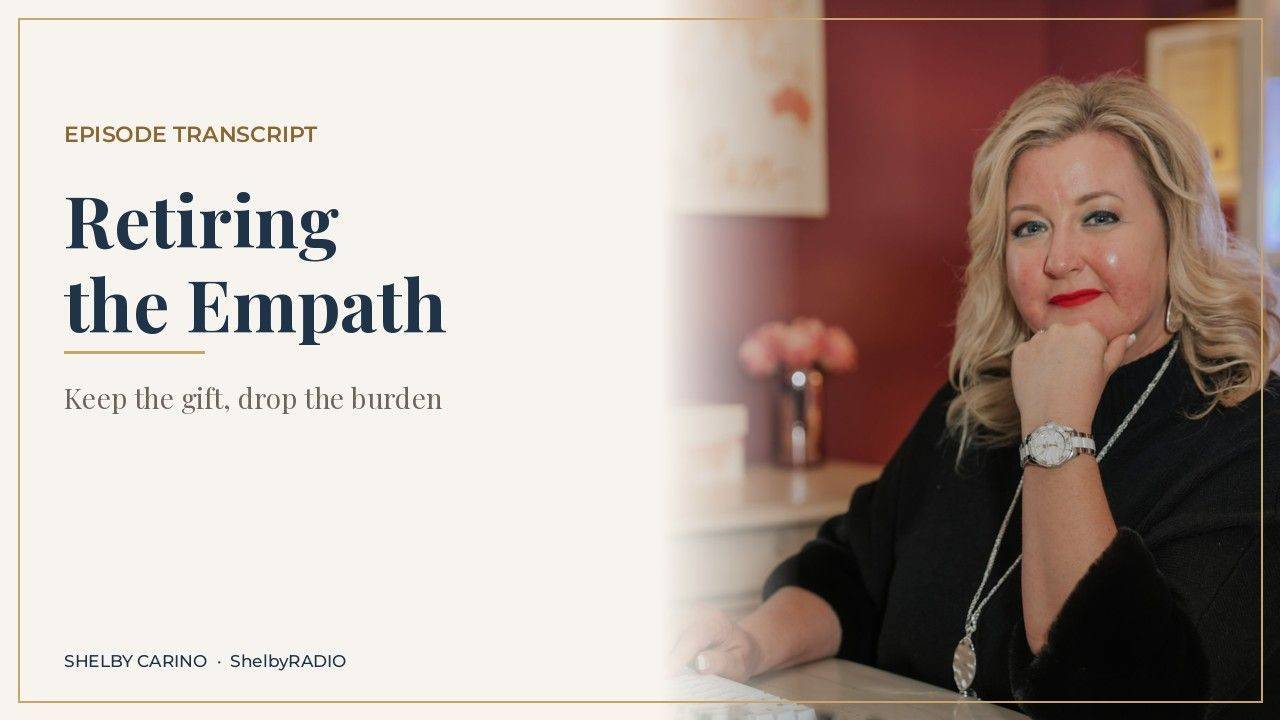
Episode transcript, ShelbyRADIO · 66 minutes
Short answer: Retiring the empath doesn't mean you stop being sensitive. It means you retire the part of you that acts as a dumping ground for other people's emotions. An empath feels other people's experiences as if they were their own, and without boundaries, that turns into carrying everyone's burdens, attracting energy vampires and feeling drained after every conversation. When you set boundaries, clear what you absorb and let others sit in their own process, your sensitivity becomes strength. You still feel for people. You just stop absorbing it for them.
Listen: ShelbyRADIO podcast · Watch on YouTube
Key takeaways
- "Empath" isn't an accolade to hang on the wall. If you get stuck in the persona, it can keep you from moving forward on your path.
- Retiring the empath means keeping your sensitivity while retiring the doormat, the garbage disposal and the martyr.
- If it's in you, it has to move through you. Whatever your energy absorbs, you're responsible for clearing.
- Taking on someone's pain can steal their experience. Sometimes the kindest thing is "ruthless compassion": letting them sit in their stuff.
- If you can't set a human boundary, you'll struggle to set a spiritual one. A 24- to 72-hour block can give you space to find your own feelings again.
- A healed empath becomes a pillar of strength for others, feeling for them without absorbing their pain.
Full transcript
Lightly edited for reading.
Why retire the empath? (00:00)
Hello, welcome to ShelbyRADIO. I am your host, Shelby Carino, and today's episode is on retiring the empath. What an interesting topic this is going to be.
Let's just get honest and real for a second. Whether you've been on this spiritually ascended path for one day, one year or 20 million years, "empath" is a word you can never escape. It follows us everywhere in spiritual ascension.
Some people get confused about what the word even means, or they think it's an accolade they want to hang on the wall so everybody knows they're an empath. I teach that there's a point in time when you have to move past the empath. If you don't, you get stuck in a persona of what an empath is, and it can actually keep you from moving forward: noticing your own feelings, emotions and thoughts, and learning to heal, harmonize, balance and integrate your sensitivities.
I wanted to share this because it's wisdom I've learned along the way. Somebody out there is going to say, "Thank God, I've been experiencing the exact same thing. I'm not on the crazy train like I thought." This is not uncommon. It's pretty normal.
What is an empath? (04:12)
So let's begin by defining what an empath is. The word comes from empathy, which is the ability to understand the experiences and feelings of other people outside of your own perspective. It's the ability to sit and listen or feel someone without putting your perspective on it, because you still feel for them.
Say someone you know has a death in their world, a kind of loss you haven't experienced yourself. As an empath, you can still understand that level of pain, even without that direct experience. It's a feeling, a sensitivity.
It's not a mental "I'm sorry you're going through that." You actually feel it in your own system as if it happened to you.
People ask me, "How do you know you're an empath?" The easiest answer is: have you always been the sensitive one in your relationships? Have you always been the one who feels what everybody else is feeling?
If so, you're probably an empath. And if we look at the metaphysical world, at the clairs, like clairaudience and clairsentience, you're probably empathic if you feel overstimulated in your emotions, your feelings, your body and your energy.
Empaths and boundaries (08:24)
You may also be part of the pack of people who really struggle with boundaries. On a spiritual awakening path, it's amazing how many of us can't say no, can't cut people out of our lives, are willing to wear the scarlet letter for someone else, or will jump in front of the sword so someone else doesn't feel the pain. We have no boundaries.
So as empathic people on this journey, we have to learn to say no, and to draw the line in the concrete, not the sand, because sand can wash away and concrete stays solid. Even changing the language is powerful, because you're finally putting your foot down: "I'm standing for myself. I will have my own appropriate boundaries, and it's okay if someone tests them."
And they will test them, because most people don't want the empath to retire. If you retire, the other person will probably have to feel their own pain. They'll have to learn, "I can't just throw my stuff onto somebody else. I need to deal with my life." They may not like your boundaries, because your boundaries challenge them to see who they are.
Our senses, our energy body, our emotional body and our physical body can get very overstimulated by the emotions people put off around us, and emotions are just energy in motion. So we have to ask, "How can I retire my empath without losing the sensitivity? Is there even such a thing?" In my world, yes. I'm always going to be sensitive.
My channels will always be open. But I can retire the part of my empath that made me feel and experience things harder than I needed to, because now I have boundaries that no longer allow me to be a dumping ground for others' emotions. That's part of the growth process.
Overwhelmed in crowds (13:04)
Another sign of being empathic is getting overwhelmed in crowds. As a kid, I never understood why I didn't like being around a lot of people, or why at a restaurant I chose to sit off to the side instead of in the middle, or why I went to movies at times when the theater wasn't full.
This is getting more common, as empathic energy begins to overwhelm people's boundaries. Think back to 2020, when restaurants had plexiglass dividers and seats were spaced apart. I didn't like that things had to shut down in our everyday lives.
But part of me loved the booth dividers, because I didn't have to listen to everyone else's conversation. And at the movies, I liked knowing nobody would sit right next to me.
Was that good for business? Probably not. But as human beings, we're not really meant to sit one on top of the other.
We all like our space, which is why more people want land, space and less populated areas. As a society, we've been on top of each other for so long that these energies and emotions are becoming more heightened and intense.
You can't think your way out (16:20)
The only way you can retire your empathic tendency to absorb is to spiritually ascend past the lower frequencies other people put off. We have to actively choose not to let certain energy in. But that's not, and never will be, a mental process.
You can't just say, "I don't want this energy in my life right now," and boom, it's gone. It doesn't work that way.
You have to earn your way out of relationships energetically, whether it's a friendship, a romance or a coworker. The only way to do that is to figure out what energy inside you is in rapport with the energy you're letting in. If your energy weren't in rapport with it, you wouldn't let it in.
It would bounce right off and go back to the other person. That's what starts you on this ascended path.
Every empath has probably had this sensitivity since childhood. You're born empathic. So along the way we learn what our empathic traits are, and then we have to take a deep dive into how to manage them.
Alone time and my nightly bath (19:08)
If you're highly sensitive, you absorb other people's emotions when they're around you. A lot of empaths are introverted. I'm more of an extrovert, but I'm also very introverted.
Empaths are also highly intuitive, and alone time is very important. If I have to go "people" out there in the matrix, I need just as much time to do "no people."
My alone time is every night, when I take an Epsom salt bath. Every single night. If we're traveling and there's no bathtub, I bring Epsom salts and sprinkle them in the bottom of the shower.
Joe knows I'll be in that bath for 20 to 30 minutes and he doesn't bother me. That's where I let go of the energy of the day. That's where I dim my light as I get ready for bed.
That alone time matters because I'm highly intuitive and I exchange a lot of energy with people in my client sessions. That sensitivity is good for me to have. It provides for my household, it lets me have influence in people's worlds, and it gives me a mission and a passion for my gifts that I never knew would go this far. I've just learned how to channel these empathic energies so they work for me, and better for the people around me.
Energy vampires (21:28)
Empaths can also get very overwhelmed in relationships with any depth of intimacy, because they pick up even more. And we've all had the conversation about energy vampires. Empaths are huge lighthouses for energy vampires.
These are people who aren't here to be of the light, yet they gravitate toward the light because that's how they get to live in some kind of light. They just don't produce it themselves.
Energy vampires have no empathic ability. They pull off the light of other people and wear it like a set of clothes. "Which outfit am I wearing today? Let me call my empath friend, take in all that energy and give her all my yucky energy, and then go about my day."
Empaths also love nature, because nature helps us fill back up. These are the traits and habits we have as empaths.
You're not a doormat (23:48)
But at the end of the day, we want to retire labeling ourselves as empaths, because in a way it's like labeling yourself a doormat. Who wants to be the doormat or the garbage disposal? If you're absorbing all the energy from your friends, family, coworkers and strangers on the street, being the martyr and taking it all in, you have to move it.
My mentor always said to me, "Shelby, if it's in you, it has to move through you." That never left my head. If your energy takes something on, you have to clear it, period.
It doesn't have to be right or wrong, fair or unfair. If your energy absorbed it, you're responsible for clearing it.
That's why retiring the empath label is the first step in recovery. It doesn't mean you ever stop being an empath. You get to be a better empath, with a more effective way to handle sensitivity to energy, without blaming other people for dumping into you.
I've heard people say there are different kinds of empaths: physical, intuitive, emotional, earth empaths. In my opinion, an empath is an empath, whether you pick up energy from people's physical ailments, their emotional tantrums, intuitive exchanges or feeling a tree in nature. If you're sensitive to energy and you feel it in your system, you have to do something with it, especially if you want a productive life.
This was my issue growing up as an empath. I noticed my voice got lower and quieter. I was always trying to shoulder everyone else's burdens: "Are you having a hard time? Release it to me so you can be more comfortable, and I'll carry around 80 tons of bricks on my back for you."
If we tell ourselves we don't do that, we're lying to ourselves. Somewhere, unconsciously, we're doing it, or we wouldn't feel so weighted down and tired.
That's what an empath does, because we don't like other people to feel bad or uncomfortable. So we say, "Here, let me carry that. I'm okay being uncomfortable." But that doesn't do the other person any good.
They need to be uncomfortable. As empaths, we have to get okay with being uncomfortable so other people can be uncomfortable.
Empaths are strong (29:24)
Do I think being an empath is a sign of weakness? Not at all. If we have all these sensitivities and we're willing to shoulder other people's emotional losses and traumas on top of our own, we have to have a lot of strength.
That's what makes us the trash can, the garbage disposal. Yet many empaths are very successful and productive, because they know how to organize and get things moving.
They're doing something with the energy most of the time, until it's time for the empath to shine the light of self onto self and deal with their own emotional trauma, their own baggage and their own pain instead of absorbing everyone else's. That's when the real journey begins. That's where they learn where their strength is, what abilities they have and what their skill sets are in the metaphysical world.
As an empath, you have to step out of other people's worlds so you don't absorb them. You can still feel for that person, but you have to put your world first. Create your truth and your boundaries.
Be your own emotional sponge, so you know where to grow. Then, when you're around other people, you have a stronger immunity and don't have to absorb their feelings and stack more burdens on yourself.
The phone call test (32:40)
How can you tell if you're really an empath? The next time you're on a phone call, or even texting, with a friend, coworker, spouse or child, notice how you feel afterward. Is that person dumping all their drama onto you, and then you hang up and think, "God, I'm so exhausted"? That's a really good sign you're an empath absorbing their emotions as if they were your own.
Suddenly you feel heavy, agitated, anxious or depressed, because now you're feeling everything they were complaining about, since they don't want to feel it themselves. Now it's in your energy field, and you have to figure out how to work it through. Do you yell at your kids or your spouse?
Go for a run? Journal? Do a clearing?
Punch a wall? Most people never stop to think, "I just absorbed something that wasn't mine," because we're so quick to assume it's us. Often it's what we're absorbing around us.
Empaths are the complete opposite of narcissists. Empaths are very good at attracting narcissists. Narcissists have zero empathy, and they thrive on admiration.
Empaths are very sensitive and in tune with others. Narcissists want everyone to admire them, while empaths just want everyone to feel better. That's why they so often end up in relationships together: the empath needs to learn to take that experience and use it to finally take care of, see and feel themselves, instead of feeling for everybody else.
Ruthless compassion (36:52)
Empaths are very big-hearted people, and because of that, we throw ourselves into trying to keep others from feeling pain. But my mentor taught me long ago, "Shelby, sometimes you just have to have ruthless compassion." Sometimes the best thing you can do is let someone sit in their stuff. You can still have empathy and compassion for them, but sometimes you have to say, "You need to sit with that for a minute."
Think about children. When a child's behavior isn't acceptable, one common form of discipline is a time-out: "Sit there and think about what you just did." We let children reflect on their choices because we're teaching them to stop and think before they act.
So if we're big-hearted and willing to take on someone's pain so they don't have to feel it, are we ethically doing the right thing? Aren't we stealing their experience of using that pain to grow stronger? Even if they say, "I don't want to feel this, you take it," they'll keep feeling that pain until they learn its lesson.
How many times does an empath need to absorb someone's pain before realizing you're never allowed to take away someone else's process? There's always a kickback when you do. There's always an exchange.
Absorbing a death: my dad (39:40)
In energy, we're always exchanging, even when someone dies. When someone close to us dies, we absorb the energy that left their physical body. Back in 2015, my dad died on a football field while refereeing a high school game.
He blew the whistle and fell flat to the ground, and his heart stopped. It was right after AEDs had been implemented in Texas high school training programs, and one of the trainers had an AED right there and got his heartbeat back by the time the ambulances arrived. The story made the local news, because if that AED hadn't been on the field that day, he may not have made it.
When he told the story, he said it started raining on the field while he was dead, though there was no weather that night, and I think he said he saw his mother, who had passed. Then he came back to life. But the energy of who he was before he died on that field was gone.
To me, he came back as a completely different soul, a walk-in. I don't even know who that person is anymore, and I don't talk to him.
My point is this. I'm the second born, and I came in to help clear my dad emotionally. When his heart stopped and that energy left his body, a lot of it went to me. My dad comes from a family of very strong empathic people.
My mother's side was not. My sister was firstborn, and that's something different with her and my mother. I was like my dad in my empathic nature, so organically, I received his death energy.
This was right before Joe and I got together. My dad died several weeks before we went on our Huna trip, and a couple of months after we got back, we made it official, moved in together and got married. It was boom, boom, boom, all within a year. I took on so much of my dad's death energy that my body was shapeshifting into aspects of him.
I picked up his traits. He used to make sausage biscuits every Christmas, and I loved them. Then I started making sausage biscuits.
When my dad's sister died, I processed some of the leftover energy from her death too. Joe would say, "Wow, you just totally shapeshifted into your dad," and I'd say, "I know. I'm clearing something that has to do with him." I've done this over the last several years, so I could connect with the male empathic side of energy within my own male energy body.
Through feeling his death energy, I could feel the suffering or stuckness my dad may have experienced in life, where he couldn't express his feelings or emotions, or couldn't reach the highest level of success he might have reached, because he kept absorbing things from my mother that held him back. It wasn't until that energy let go and I picked it up that I learned, "Oh, that's what that feels like. Let me clear it. Where am I running that in my life? Where don't I want to run it anymore?" Fine, let me make some sausage biscuits and clear it through, with no judgment. I came to understand at a deeper level who my dad was, because I was taking those energies on.
As we move into a higher level of consciousness, and as people close to us cross over, if you're an empath who absorbs the energy around you and you haven't built boundaries or learned to navigate this yet, you're very susceptible to absorbing the energy of someone close to you who passes, so you can learn what you need to learn from it. That's why you need the right information, your tools and your skill sets.
A neighbor's passing and the maternal line (48:32)
Recently, a neighbor we were very close to died unexpectedly. I had a close relationship with her, and as the months passed, I began feeling the effects of her death, feeling for her and the life she lived, and absorbing a lot of that energy, because she was part of our daily lives.
She showed up in my dreams several times, showing me she'd made it to the light, that she was working her process and was happier now. That floored me, because I didn't think I'd experience that. But I'm a worker of the light, and I'm still helping carry some of that energy through, for whatever purpose it serves. I obviously couldn't help absorbing it, because there's a boundary or an immunity I'm meant to build through this, so I can share that knowledge with someone else when the time comes.
Once you get really good at understanding how this works, you realize you only take on what you need to take on, because you're really just clearing yourself. When we take things on from other people, it's an example of something we haven't cleared in ourselves, and an opportunity to use that energy to clear it. If we don't clear it, we just keep taking on more and more and never get anywhere. That's why spiritual accountability is so important for moving forward in healing.
So why was she so instrumental? Years before, my dad's energy let go, so I knew what it felt like to clear the death energy of my father. But I haven't talked to my parents since really his death, and I hadn't experienced the energy of my mom being off the planet.
This neighbor really reminded me of my mother: her hairstyle, her actions, her demeanor. I'd always say, "Oh my gosh, she's just like my mother."
When she crossed over, I had an emotional attachment to that, an emotional absorption of her death. That let me run the process of healing the maternal energy of a parent, because I'd only done it on my father's side. I got to run it through as if I'd lost my mother, even though it was this other woman.
As humans, we want to say, "I'm good, I'm not doing this anymore," or "That's not why this is happening." But if we acknowledge what's really happening, take accountability and grab the bull by the horns, we can have a beautiful transition and a beautiful boundary at the end of it that will help other people down the road, because we're stronger as an energy.
From martyr to pillar of strength (53:40)
So what you really want to retire is the part of the empath that's a dumping ground, the martyr. Then you can step into recovery and become the strength of a warrior for those going through hard times, through depression, anxiety, death and trauma. When we go through painful events, we look for people who are stronger than us in that moment, who can be a pillar of strength and stay objective while we heal. That's what every empath should strive to be.
When others call on that strength, your energetic immunity is strong and stable, and it has boundaries. You're still empathic. You still feel for them.
You just aren't absorbing it for them. That's why healthy boundaries with loved ones, especially children, are so important.
If you can't set a human boundary, how will you ever learn to set a spiritual one? Let that sink in. A human boundary is tangible, out-here stuff. A spiritual boundary looks like being strong spiritually, and only you know where you're strong, based on what you bring into your world and how those experiences affect you.
The 72-hour block (57:24)
Here's an example. If I know someone is an empath and something is going on with a coworker, a relationship or their kids, I'll tell them to put a block on it, and I use the word block on purpose. Say you're dating someone and you need to break up, but you can't, and they keep contacting you. I'll say, "Block them for 24 to 72 hours."
I'm testing them, because they're used to that person coming in. Part of them wants it, or they're getting some excitement from the friction, even though it spins them out emotionally every time. They say, "I'll feel so bad if I do that." Well, you feel bad now, so what's the difference?
This is about you now, not them. If you don't put up a block to stop that person's emotions from constantly hitting you, how will you ever get to your own clarity? You won't.
If someone is treating you poorly and it's time for their texts and calls to stop coming through, it's up to you to go on a 72-hour block. You're telling your subconscious mind that person can't reach you for that time. It's like a time-out for you, so you can get right with who you are as a feeler, figure out your feelings again without someone constantly dumping into your field, and start getting stronger and clearer.
After 72 hours, I tell clients they can unblock the person and test it. What happens? Do you feel anxious, depressed, panicky or angry again?
If so, put them back on block, because you haven't learned enough yet. And if you say, "But that's my child's father," or "my child's mother," then plan when you can go on block, maybe communicate by email, or do it when nothing is going on with the kids. There's always a way to protect your energy and your boundaries.
You're not a landfill (61:36)
You have to have the courage to stop the insanity so you can see it, because when you see it, you can heal it. Setting boundaries, journaling and noticing when you're emotionally overloaded help you step into positive traits that retire the empath and move the empath into recovery.
Then the empathic part of you emerges as strength and power. Imagine how much empowerment your energy can give other people when they step into your space and are met with that strength. That's what we should be doing as empaths. But it starts with us.
We have to heal that part of our empath first and retire being the garbage disposal, the dumping ground. We're not a landfill. We have to step up and hold the boundary that says, "I'm no longer the landfill," and the only way to do that is to empower your energy.
The empath label is something so many people think is an accolade, but it's really one of the hardest things to overcome and recover from as a spiritual being. I hope this gave you some insight into your walk as an empath, and that wherever you are on that journey, it serves you moving forward. Until next time, have a good day.
Frequently asked questions
What does it mean to retire the empath?
It means keeping your sensitivity while retiring the part of you that acts as a dumping ground for other people's emotions. You still feel for others, but with boundaries in place, you stop absorbing and carrying their pain for them.
How do I know if I'm an empath?
You've likely always been the sensitive one who feels what everyone else is feeling. You may get overwhelmed in crowds, need a lot of alone time and feel heavy, anxious or exhausted after someone vents to you. If that heaviness or anxiety lingers, please also talk with your doctor.
Why do empaths attract narcissists and energy vampires?
Narcissists have no empathy and want admiration, while empaths want everyone to feel better, so the two often end up together. Energy vampires are drawn to an empath's light because they don't produce their own. The lesson for the empath is to turn that care back toward themselves.
How can an empath set boundaries?
Start with human boundaries, like saying no and blocking someone's texts and calls for 24 to 72 hours so you can feel your own feelings again. Then test it. If old anxiety or anger returns when you unblock them, you need more time.
Where to go next
- Start here: my free 16-minute audio, When You Don't Feel Like Yourself
- The course: Protect Your Energy, simple tools to keep your energy clear, grounded and your own
- Listen next: The Biggest Mistake an Empath Makes
- Work with me one-on-one: private sessions