
The Track Has Changed: Why Your Old Way of Doing Life Doesn't Work Anymore
Oct 06, 2026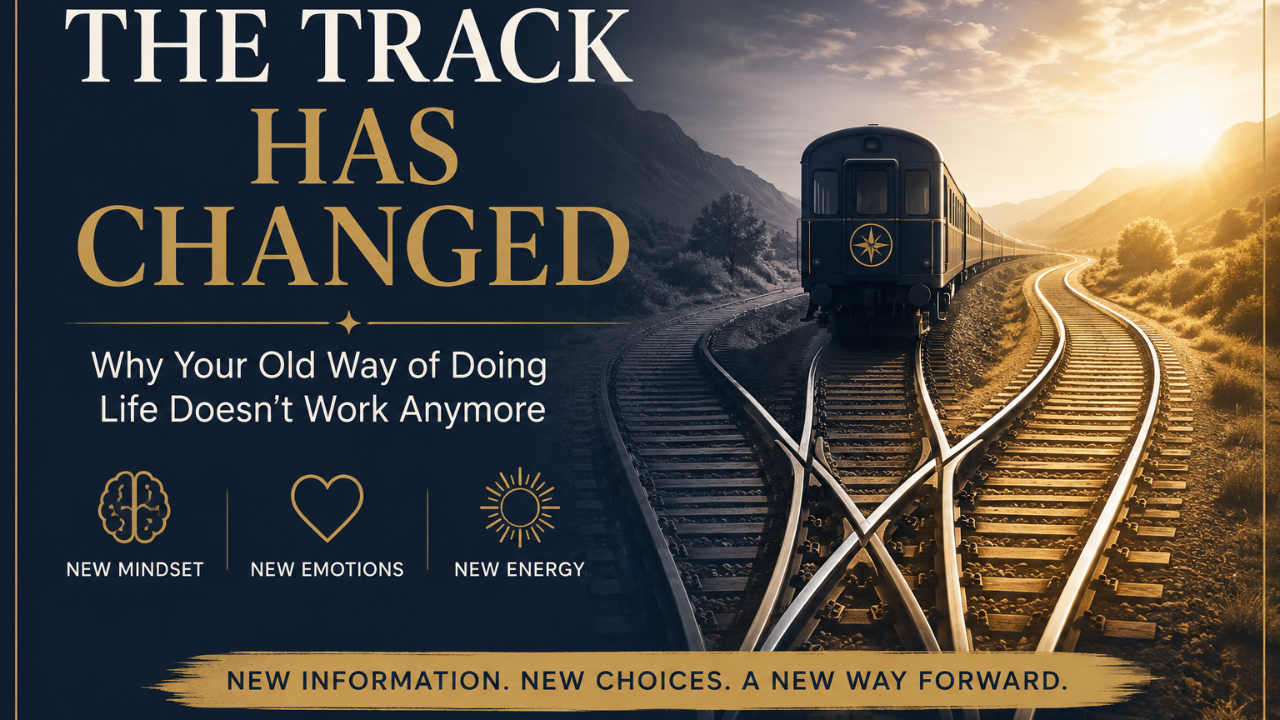
Imagine you've been riding the same train for most of your life.
You've traveled the route so many times that you barely have to think about it anymore.
You know where the train slows down. You know where it turns. You recognize the scenery outside the window. You know what comes next.
Then one day, the track switches.
You're still sitting on the same train. You're looking through the same windows. You're carrying much of the same luggage.
But something feels different.
The old map doesn't match where you're going anymore.
And I think that's where a lot of people are finding themselves right now.
Maybe you've noticed that the way you used to handle things doesn't work like it once did.
The conversations you used to tolerate feel different.
The things you used to chase aren't as interesting.
Your old coping mechanisms don't give you the same relief.
You can't talk yourself into something quite as easily anymore.
Maybe you're responding differently in relationships. Maybe you're questioning things you've believed about yourself for years. Maybe you're becoming more aware of your emotional patterns, your nervous system responses, your habits, or the ways you've learned to survive.
You may not even know exactly what has changed.
You just know something has.
The track has changed.
And when the track changes, eventually the information you're using to navigate your life has to change too.
Why Do Old Patterns Stop Working?
Most of us develop patterns long before we realize they're patterns.
Something happens, and we react.
Someone disappoints us, and we respond the way we've learned to respond.
We feel uncomfortable, and we reach for whatever has helped us escape, control, soothe, avoid, fix, or make sense of that feeling in the past.
Do something enough times and it becomes familiar.
Eventually, you don't have to consciously choose the response anymore.
The response chooses itself.
A situation happens.
A familiar thought appears.
The thought creates a familiar emotional response.
The emotion leads to a familiar behavior.
And the familiar behavior often creates a familiar result.
Then the cycle begins again.
That becomes your track.
It doesn't necessarily mean the pattern is healthy, helpful, or even aligned with who you are now.
It simply means you've traveled that route enough times that your mind and body know the way.
That's one reason personal growth can feel so uncomfortable.
You're not only changing what you're doing.
You're interrupting what has become familiar.
What Does It Mean When You Feel Like You're Changing?
There are seasons when you can feel yourself changing before you have words for what is happening.
You might say:
"I don't know what's wrong with me."
"Why don't I want the things I used to want?"
"Why am I reacting differently?"
"Why can't I go back to how things were?"
"Why does everything suddenly feel different?"
Sometimes nothing is wrong.
Sometimes you're simply becoming aware of information you've been running unconsciously for years.
Beliefs.
Expectations.
Relationship patterns.
Coping mechanisms.
Definitions of success.
Ideas about who you're supposed to be.
Ways you've learned to earn love, approval, safety, belonging, or validation.
You begin noticing the track while you're still riding on it.
And once you can see a pattern clearly, it becomes much harder to pretend you don't see it.
That's when change really begins.
Your Brain Likes What Is Familiar
One of the most important things to understand about changing old patterns is that familiar and healthy are not the same thing.
Your brain is incredibly efficient.
The more often you think a thought, perform a behavior, or respond to a particular situation in the same way, the more familiar that pathway becomes.
That's useful when you're learning how to drive a car, type on a keyboard, make your morning coffee, or perform any task you don't want to consciously relearn every day.
But automatic patterns can also develop around emotional responses.
Maybe your automatic response to uncertainty is worry.
Maybe conflict immediately makes you defensive.
Maybe disappointment sends you into withdrawal.
Maybe feeling overwhelmed makes you avoid everything.
Maybe someone else's mood causes you to abandon your own emotional center and start managing theirs.
Maybe you learned that being needed made you valuable.
Maybe productivity became connected to worth.
Maybe control became connected to safety.
You didn't necessarily sit down one day and consciously choose these patterns.
Many of them were built through repetition, experiences, relationships, family systems, cultural expectations, stressful periods, and the ways you learned to navigate life.
Eventually, the response became familiar.
And familiar can feel safe even when it isn't serving you anymore.
What Happens When the Old Response No Longer Fits?
This is where things can get interesting.
The old pattern still appears...
but something inside you doesn't want to follow it anymore.
You get triggered, but instead of immediately reacting, you notice yourself reacting.
You start writing the angry text and then stop.
You feel the urge to explain yourself and suddenly wonder why you need to.
Someone misunderstands you, and instead of spending three days trying to change their perception of you, you let them have their perception.
Something feels uncertain, and rather than immediately trying to control the outcome, you wait.
You feel uncomfortable without automatically assuming discomfort means something is wrong.
These moments might seem small.
They're not.
They're evidence that you're beginning to create a different response.
The old track might have looked like this:
Trigger → automatic thought → familiar emotion → familiar behavior → familiar result.
The new track begins to look more like this:
Trigger → awareness → pause → different interpretation → intentional response → different experience.
That pause changes everything.
Because the pause gives you something the old pattern didn't have.
Choice.
Why Does Personal Growth Sometimes Feel Wrong?
This is one of the strangest parts of changing your life.
Sometimes the healthier response feels more uncomfortable than the old one.
Not because it's wrong.
Because it's unfamiliar.
Think about how strange it can feel the first time you stop overexplaining.
Or set a boundary.
Or don't immediately answer.
Or rest without earning it.
Or allow someone else to solve their own problem.
Or stop chasing closure.
Or say no without providing a five-paragraph explanation.
Your mind may immediately begin producing reasons you should go back.
Maybe I should text them.
Maybe they're mad.
Maybe I was too harsh.
Maybe I should explain.
Maybe I should just do it myself.
Maybe I shouldn't have said anything.
That doesn't automatically mean you made the wrong decision.
Sometimes you're simply experiencing the discomfort of stepping out of an old pattern.
You're traveling somewhere your internal system hasn't traveled very often yet.
Of course it feels different.
It's a new track.
You Can't Use an Old Map for a New Life
This may be one of the biggest mistakes we make during periods of personal transformation.
We recognize that something is changing, but we continue trying to navigate it using old information.
We want a different relationship while responding from the same wounds.
We want peace while continuing to feed the same thoughts.
We want a different life while maintaining the same definition of who we're allowed to be.
We want to feel differently without changing what we're repeatedly telling ourselves.
We want new results while continuing to run the same internal programming.
Eventually, something has to change.
Sometimes the question isn't:
"Why isn't this working anymore?"
The better question may be:
"Why am I trying to make an old response work in a place that requires something new from me?"
That's a very different question.
And it can create a very different answer.
A New Track Requires New Information
Changing your patterns doesn't mean becoming an entirely different person.
In many ways, it may mean becoming more of yourself.
But instead of automatically running every belief, reaction, and coping mechanism you've accumulated throughout your life, you begin deciding what actually belongs to you now.
Maybe the old information said:
I need everyone to understand me.
The new information says:
I can be understood by some people and misunderstood by others and still know who I am.
Maybe the old information said:
I need to fix this immediately.
The new information says:
I can give this some space before I respond.
Maybe the old information said:
If I'm uncomfortable, something must be wrong.
The new information says:
Discomfort can also mean I'm learning something new.
Maybe the old information said:
I need to know exactly what's going to happen before I move.
The new information says:
I can know my next step without knowing the entire journey.
Maybe the old information said:
This is just who I am.
The new information asks:
Is it who I am—or is it what I've practiced?
That question alone can change a lot.
How Do You Start Changing Old Emotional Patterns?
You don't have to reinvent your entire life overnight.
You start by noticing.
Notice the moment before the familiar response.
Notice what happens in your body.
Notice the thought that immediately appears.
Notice the story you begin telling yourself.
Notice what you suddenly feel compelled to do.
Then ask:
Is this what I actually want to do, or is this simply what I've always done?
That small moment of awareness creates space between the stimulus and your response.
And inside that space, you can begin practicing something different.
Maybe you wait ten minutes before responding.
Maybe you take a walk.
Maybe you breathe.
Maybe you write down what you're feeling before turning it into action.
Maybe you ask yourself what you actually need.
Maybe you decide this particular situation doesn't require your energy at all.
The new response may feel awkward at first.
That's okay.
You're practicing.
And what you practice begins to become familiar.
Mind, Emotions and Energy Begin to Work Together
Changing a pattern isn't only about positive thinking.
You can repeat a new thought all day long, but if your emotional responses and behaviors continue reinforcing the old pattern, very little changes.
Real transformation becomes much more powerful when your mind, emotions, body, and energy begin moving in the same direction.
Your mind says:
I'm willing to see this differently.
Your emotions begin learning:
I can feel something without automatically reacting to it.
Your body begins learning:
This new response can be safe too.
And energetically, you stop feeding the same cycle over and over again.
Little by little, the new way becomes less foreign.
Then one day something happens that would have completely thrown you six months ago...
and you respond differently.
You don't have to remind yourself.
You don't have to force it.
You just respond differently.
That's when you realize:
The new track is becoming familiar.
Not Everyone Will Choose a Different Track
We are living through a time when many long-standing ideas about work, relationships, success, identity, wellness, communication, emotional health, and how we're "supposed" to live are being questioned.
New information is everywhere.
But having access to new information doesn't automatically create transformation.
A new track can become available without someone choosing to take it.
We can continue reinforcing the familiar.
We can keep repeating the same response because we've always responded that way.
We can reject anything that challenges what we already believe.
Or we can become curious.
What if there's another way to do this?
What if I don't have to respond the way I've always responded?
What if something I've believed about myself isn't actually true anymore?
What if the discomfort I'm feeling isn't telling me to go backward?
What if it's teaching me how to move forward differently?
That's an individual choice.
No one else can make it for us.
Maybe You're Not Lost. Maybe the Map Changed.
If you've been feeling different lately, pay attention before automatically trying to make yourself feel like the old version of you again.
You may not need to go backward.
You may need new information.
A new perspective.
A different response.
A different boundary.
A different relationship with your emotions.
A different understanding of yourself.
And yes, learning a new way of navigating life can feel disorienting.
There may be moments when the old track looks easier simply because you know where it goes.
But you also know where it goes.
You've already traveled it.
Maybe the question now isn't how to get back to who you were.
Maybe it's:
Who am I becoming now that I don't have to keep responding to life the way I always have?
You don't need the entire map today.
You don't need to know every stop.
You don't even need to understand exactly where this new track eventually leads.
You simply have to become conscious enough to recognize when you're being invited to respond differently.
Because maybe your life isn't going off the rails.
Maybe you're finally learning how to travel on a different track.